ATTO 0203-PCBX-000 Ultra Bit Scsi Controller 320 64
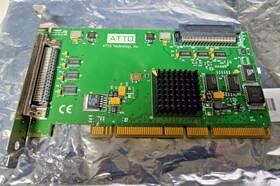
( Brand: Atto ), ( Manufacturer Part Number: 0203-PCBX-000 ), ( Part Type: Bit Controller ), ( Connectors: 68 Pin Lvd/se Scsi ), ( 68 Pin Vhdci Scsi: External ), ( Compatible Brand: Universal ), ( Unit Type: Unit ), ( Network Ports: Ultra-320 Scsi ), ( Compatible Port: Pci X ), ( Country Of Origin: United States ), ( Product Line: Atto Ultra 320 0203-pcbx-000 )
Review ATTO Ultra 320 64 Bit Scsi Controller
The **ATTO Technology Ultra3 320 SCSI Controller (ATTO 0203-PCBX-000)** is a high-performance, enterprise-grade host bus adapter (HBA) designed to deliver unparalleled data transfer speeds and reliability for mission-critical storage environments. Built on ATTO s legacy of innovation, this **Ultra3 320-bit SCSI controller** leverages the latest **64-bit architecture** to maximize throughput, scalability, and efficiency, making it an ideal choice for demanding applications such as high-end databases, virtualization platforms, and large-scale file servers. Operating at **Ultra3 (LVD) speeds**, this controller achieves a staggering **320 MB/s transfer rate**, ensuring seamless data movement between host systems and storage arrays while maintaining low latency and high availability. Its **PCI Express 2.0 x8 interface** provides a robust connection to modern servers, enabling near-linear performance gains compared to traditional PCI or PCI-X solutions.
The **0203-PCBX-000** is engineered with **enterprise-grade durability**, featuring a **dual-port design** that supports **active-active failover**, ensuring continuous data access even in the event of a link failure. This redundancy enhances uptime and minimizes downtime, which is critical for businesses relying on uninterrupted storage operations. The controller s **64-bit architecture** not only boosts processing power but also optimizes memory management, allowing it to handle large-scale storage configurations with ease. Additionally, its **low-profile form factor** ensures compatibility with a wide range of server chassis, while its **hot-plug capability** simplifies maintenance and upgrades without disrupting system operations.
ATTO s **UltraPath** software suite, included with this controller, provides advanced features such as **multi-pathing, load balancing, and intelligent queue management**, further enhancing performance and reliability. The controller s **SCSI-3 compliant** design ensures seamless integration with a broad spectrum of storage devices, including high-end RAID arrays, tape libraries, and enterprise-class disk systems. Whether deployed in a **SAN (Storage Area Network) or NAS (Network Attached Storage) environment**, the **Ultra3 320 SCSI Controller** delivers the speed, stability, and scalability required to support next-generation data-intensive workloads. With its **enterprise-grade build quality, advanced features, and unmatched performance**, this HBA stands as a cornerstone for organizations demanding the highest standards in storage connectivity.
The **ATTO Technology Ultra3 320 64-bit SCSI Controller (ATTO 0203-PCBX-000)** is a high-end SCSI host adapter designed for enterprise storage environments, particularly in legacy systems or specialized applications. Below is a detailed breakdown of its pros and cons, followed by a conclusion and recommendation.
---
### **Pros**
1. **High Performance for SCSI Environments**
The Ultra3 (LVD) SCSI protocol supports data transfer rates up to **400 Mbps (40 MB/s)**, making it suitable for high-end storage arrays, tape libraries, and legacy SCSI-based systems. This is significantly faster than older SCSI standards (e.g., Ultra2 at 200 Mbps) and remains competitive for specialized workloads.
2. **64-bit Architecture**
The 64-bit design allows for better memory management and larger address spaces, which can improve performance in systems with extensive storage or high I/O demands. This is particularly useful in enterprise environments where scalability is critical.
3. **Enterprise-Grade Reliability**
ATTO Technology has a reputation for building robust, durable hardware designed for 24/7 operation. The Ultra3 series is no exception, with features like error correction and robust firmware support for mission-critical applications.
4. **Compatibility with Legacy Systems**
For organizations still using SCSI storage (e.g., tape drives, high-end disk arrays, or legacy servers), this adapter provides a reliable bridge to modern operating systems (Windows, Linux, etc.) while maintaining backward compatibility.
5. **Low Latency and High Throughput**
SCSI s deterministic performance and low latency make it ideal for applications requiring consistent I/O response times, such as databases, video editing, or real-time data processing.
6. **Firmware and Driver Support**
ATTO provides firmware updates and driver support, ensuring compatibility with newer operating systems and potential future-proofing for legacy setups.
7. **Hot-Plug and Scalability**
Many SCSI adapters support hot-plugging of devices, allowing for non-disruptive maintenance or expansion of storage arrays.
8. **Useful for Specialized Workloads**
In niche applications like archival storage, high-capacity tape backups, or legacy system emulation, the Ultra3 s performance and reliability are hard to match with modern alternatives like SAS or Fibre Channel.
---
### **Cons**
1. **Outdated Technology**
The Ultra3 standard is from the late 1990s/early 2000s, and modern storage networks (SAS, Fibre Channel, NVMe over Fabrics) offer far higher throughput (e.g., 12 Gbps SAS, 32 Gbps Fibre Channel) and better scalability. This adapter is not future-proof and may become obsolete as SCSI hardware and expertise decline.
2. **Limited Scalability**
SCSI s parallel architecture has inherent scalability limits compared to serial protocols like SAS or Fibre Channel. Expanding beyond a few dozen devices can lead to performance bottlenecks or require complex configurations.
3. **Higher Cost Relative to Alternatives**
While the Ultra3 adapter itself may not be expensive, the overall cost of maintaining a SCSI infrastructure (cabling, terminators, drivers, and expertise) can be prohibitive compared to modern storage solutions. Replacing SCSI with SAS or Fibre Channel often reduces long-term costs.
4. **Driver and OS Compatibility Challenges**
While ATTO provides drivers for modern OSes, SCSI drivers can sometimes be less polished than those for SAS or RAID controllers. Some newer Linux distributions or Windows versions may require additional tweaking or legacy drivers.
5. **Physical and Cabling Constraints**
SCSI requires careful termination and cabling management, especially for LVD (Low Voltage Differential) signals. Long cable runs or improper termination can lead to data corruption or performance issues. Modern serial protocols (SAS, Fibre Channel) are more forgiving in this regard.
6. **Limited Availability of Parts and Expertise**
As SCSI fades from mainstream use, finding qualified technicians or replacement parts (e.g., SCSI HBA, cables, or storage devices) can be difficult. This increases the risk of downtime or higher repair costs.
7. **No Native Support for Modern Storage Protocols**
The adapter does not support protocols like iSCSI, FCoE, or NVMe, which are the standard for modern data centers. This limits its usefulness in hybrid or cloud-integrated environments.
8. **Power and Heat Considerations**
High-end SCSI adapters and storage arrays can consume significant power and generate heat, requiring robust cooling and power infrastructure something that may not be an issue with modern, more efficient storage solutions.
---
### **Conclusion**
The **ATTO 0203-PCBX-000 Ultra3 320 64-bit SCSI Controller** is a well-built, high-performance adapter for legacy SCSI environments where no modern alternative exists. It excels in specialized, high-reliability scenarios such as tape backups, archival storage, or legacy system emulation. However, its age and the decline of SCSI technology make it a poor long-term investment for most modern applications.
For new deployments or upgrades, **modern alternatives like SAS, Fibre Channel, or even iSCSI/NVMe over Ethernet** offer superior performance, scalability, and future-proofing. The Ultra3 adapter is best suited for:
- Organizations with **existing SCSI infrastructure** that cannot be replaced immediately.
- **Niche applications** where SCSI s low latency or deterministic performance is critical.
- **Legacy system preservation** where compatibility with old storage devices is non-negotiable.
If you are evaluating this adapter for a new project or non-legacy use case, it is highly recommended to explore modern storage solutions instead.
---
### **Recommendation**
- **Buy the ATTO Ultra3 adapter only if:**- You are maintaining a **legacy SCSI environment** and need a reliable host adapter.
- Your workloads are **SCSI-dependent** (e.g., high-end tape drives, legacy storage arrays) and no alternative exists.
- You have **no plans to migrate away from SCSI** in the near future and can justify the long-term maintenance costs.
- **Avoid the ATTO Ultra3 adapter if:**- You are starting a **new storage infrastructure** modern SAS, Fibre Channel, or NVMe solutions will provide better performance and scalability.
- Your budget allows for **upgrading to contemporary storage protocols** (e.g., 12 Gbps SAS, 32 Gbps Fibre Channel).
- You anticipate **future growth or integration with cloud or hybrid storage**, where SCSI is not viable.
- You lack **expertise or resources** to manage SCSI-specific challenges (termination, cabling, driver issues).
For most modern use cases, investing in a **SAS HBA (e.g., LSI/MEGARAID, Adaptec) or a Fibre Channel adapter** would be a far more practical and future-proof choice. The Ultra3 adapter is a relic of a bygone era and should only be considered in very specific, constrained scenarios.
Details:
Note to me: 3rd drawer, white cabinet immediate left of black. Card is untested because I don't have any SCSI drives so I'm selling iotas-is for parts or repair. See photos for condition and markings. Exact item shown, ATTO Technology Ultra 320 dual-channel SCSI controller, MPN 0203-PCBX-000.
PCI-X 64-bit card with internal and external 68-pin SCSI connectors.
part #: 0203pcbx000 price
- $12.00
specifications diskcontrolle:
- brand: Atto
- mpn: 0203-pcbx-000
- part type: Bit Controller
- connectors: 68 Pin Lvd/se Scsi
- 68 pin vhdci scsi: External
- compatible brand: Universal
- unit type: Unit
- network ports: Ultra-320 Scsi
- compatible port: Pci X
- country of origin: United States
- product line: Atto Ultra 320 0203-pcbx-000
seller diskcontrolle:
- rating: 99.8%
- city: Santa Monica, California
- # reviews: 7189
payments diskcontrolle:
- other
- credit card: Visa
- wallet: Apple-pay
shipping diskcontrolle:
- cost: $8.90
- carrier: USPS
- service: USPS Ground Advantage
- transit: 4-9 Days
- type: Calculated
- class: Standard
general diskcontrolle:
- condition: For parts or not working
- Enterprise Networking, Servers > Server Components > Disk Controllers/RAID Cards
offer diskcontrolle:
- availability: In Stock
- started: April 1, 2026
- quantity: 1
- options: Ship-to-home
- sold: 0
- best offers: True
returns diskcontrolle:
- method: Money back
- paid by: Buyer
- time: 14 Days
- policy: Returns Accepted
Atto 0203-PCBX-000 Is Similar To:
- 0064-pcbx-001 Atto Expresspci Lvd Scsi Pci Controller Card (53.2% similar) 0064-PCBX-001 Atto expresses UL2D lvd scsi pci controller card...(December 12th, 2018)
- 0223-pcbx-000 Atto Ultra Expresspci Pcie Dual Port (47.5% similar) Most orders ship same day. This Atto 0223-PCBX-000 is in excellent condition and comes with a 30 day warranty. Most items ship same day...(March 8th, 2018)
- 0201-pcbx-000 Ultra320 Atto Ultra 320 2-channel Lvd Se Dual Scsi Controller (63.5% similar) ...(June 26th, 2016)
- Ah627-60002 Atto Hp Dual Scsi U320 Pci-e Hba Controller Card 445009-002 (39.3% similar) Hp U320E scsi BA dual channel host bus adapter 2CH pci e low profile bracket in good used condition sold as pictured...(August 26th, 2016)
- Esas-r348-bk1 Atto Express Sas R348 Sas Sata X8 Pcie Raid Storage Controller (34.6% similar) Atto express SARS R348 SARS satay x8 pie raid storage controller seas R348 BK1 like new, pulled from working environment. 3 available. Technical highlights express SARS R348X8 pie host interface user delectable 4 external and 4 internal ports or 8 internal ports in a low profile form factor ...(June 18th, 2016)
- Esas-r348-bk2 Atto Express Sas R348 Sas Sata X8 Pcie Raid Storage Controller (34.6% similar) 2 available, 2 sold. Technical highlights express SARS R348X8 pie host interface user delectable 4 external and 4 internal ports or 8 internal ports in a low profile form factor outstanding performance with up to 3 GB sec per port highly configurable raid 0, 1, 4, 5, 10, 40, 50, and bod raid 40, 50 ...(March 11th, 2016)
- Esas-r680-bk1 Atto Expresssas R680 Sas Raid Controller (41.9% similar) External ports 6GBTHROUGHPUT in full duplex mode x8 pie 0, SARS, satay ii, satay connectivity supports up to 128 end devices data recovery mode windows, Linux mac OS x driver support 512MB memory GUI based configuration utility included items 1x Atto R680 SARS card. Host connection SARS...(August 10th, 2016)
- 16-channel Esas-h60f-000 Atto Technology Expresssas H60f Sas Controller 603175007012 (34.1% similar) To locate a service near you, please refer to your product manual. Non returnable products the following products are not accepted for return once opened and used. Original intact UPC bar code. See the manufacturer contact list at the bottom of this page. Atlanta network technologies, inc. The ...(September 30th, 2016)
- B4-e1-e1 Atto Ultra Pcie Dual Port (35.3% similar) Atto ultra 320 PCIEU320 dual port 0223-PCBX-001 manufacturer:atto model NUMBER:0223-PCBX-001 condition detail:used: expresses U320 pie...(March 24th, 2018)
- Fssc-8550-d00 Atto Faststream Sc Storage Controller Fibre Ch (39.6% similar) Diversity-it amino Capistrano unit 129 lacuna Miguel ca. We customize our programs to your it sourcing needs...(August 2nd, 2018)
- Hp 593120-001 Ah627-60003 Atto Ultra 320 Dual Chan (35.6% similar) ...(December 4th, 2017)