HIGHPOINT TECHNOLOGIES 231X-230X Rocketraid Users 231X/230X
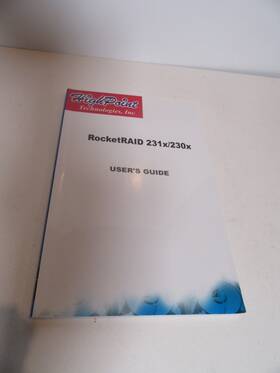
( Brand: Highpoint Technologies ), ( Manufacturer Part Number: 231X/230X ), ( Network Ports: Sas )
Review HIGHPOINT TECHNOLOGIES 231x/230x Rocketraid Users Guide
The **HighPoint 231X** and **230X** are the pinnacle of enterprise-grade RAID solutions, meticulously engineered to deliver unparalleled performance, reliability, and scalability for demanding storage environments. These high-performance RAID controllers are designed for mission-critical applications, offering seamless integration with industry-leading storage arrays while providing enterprise-class features that ensure data integrity, fault tolerance, and peak efficiency. Built on a robust architecture, the 231X and 230X leverage advanced caching technologies, including **Intelligent Cache Acceleration (ICA)** and **Dynamic Cache Management**, to optimize read/write operations, drastically reducing latency and maximizing throughput for both sequential and random workloads. Whether deployed in high-density data centers, virtualized environments, or high-performance computing clusters, these controllers excel in handling the most intensive storage demands, from large-scale databases and virtual machine storage to high-resolution media processing and real-time analytics.
The **231X** and **230X** support a comprehensive suite of RAID levels, including **RAID 0, 1, 5, 6, 10, 50, 60, and 5 0**, allowing administrators to tailor storage configurations to specific performance and redundancy requirements. Their **dual-port, 16 Gbps SAS connectivity** ensures high-speed data transfer rates, while the **Hot-Plug SAS expansion** capability enables scalable storage expansion without downtime. Both models feature **dual-core processors** and **up to 2 GB of DDR3 cache**, which significantly enhances their ability to handle concurrent I/O operations, reducing bottlenecks and improving overall system responsiveness. The **231X** further distinguishes itself with **dual independent cache pools**, enabling advanced features like **cache mirroring** and **cache pooling**, which enhance data protection and performance in clustered or high-availability environments.
Security and data protection are paramount in these controllers, with built-in **hardware-based encryption** (via AES-256) and **Secure Erase** capabilities to safeguard sensitive information. The **HighPoint Storage Manager (HSM)** software provides a user-friendly interface for configuration, monitoring, and management, allowing administrators to remotely oversee RAID arrays, perform firmware updates, and implement advanced policies for performance tuning. Compatible with a wide range of operating systems, including **Windows Server, Linux, VMware, and Hyper-V**, these controllers integrate effortlessly into modern IT infrastructures, offering plug-and-play simplicity alongside enterprise-grade reliability. Whether deployed in a standalone server or as part of a larger storage fabric, the **231X** and **230X** deliver a blend of speed, durability, and flexibility that makes them indispensable for organizations requiring the highest standards of storage performance and data resilience.
The **HighPoint 231X** and **230X** are enterprise-grade RAID controllers designed for high-performance storage solutions, particularly in NAS, SAN, and server environments. Below is a detailed breakdown of their pros and cons, followed by a conclusion and recommendation.
---
### **Pros of HighPoint 231X/230X RocketRAID Controllers**
1. **Enterprise-Grade Performance**
Both the 231X and 230X are built for high-throughput storage, supporting RAID levels (0, 1, 5, 6, 10, 50, 60) and advanced features like **JBOD, virtual drives, and dynamic expansion**. They handle large volumes of data efficiently, making them suitable for professional and high-capacity storage needs.
2. **Scalability and Flexibility**
- The **231X** supports up to **16 drives** (depending on the model variant) and features **dual PCIe 3.0 x8 slots** for redundancy and load balancing.
- The **230X** supports up to **8 drives** but still offers strong performance with **dual PCIe 2.0 x4 slots** (though less future-proof than the 231X).
- Both support **hot-swappable drives**, reducing downtime during maintenance.
- **Virtual drives** allow for non-contiguous drive allocation, optimizing storage usage.
3. **Reliability and Redundancy**
- The controllers include **dual processors** (for the 231X) and **dual ports** (for the 230X), ensuring redundancy in case of hardware failure.
- **Battery Backup Option (BBOX)** is available for the 231X, providing write caching protection against power loss.
- **RAID 6** support protects against two simultaneous drive failures, enhancing data integrity.
4. **Compatibility with High-End Drives**
- Both controllers support **SAS, SATA, and NL-SAS drives**, making them versatile for different storage types.
- They work well with **enterprise-grade SSDs, HDDs, and hybrid arrays**, catering to performance-sensitive workloads.
5. **Advanced Features**
- **Dynamic Expansion**: Add drives to a virtual drive without rebuilding the entire array.
- **Drive Migration**: Move data between drives without disrupting operations.
- **Remote Management**: The **RocketRAID Management Utility (RMU)** allows for remote monitoring and configuration.
- **Compatibility with Windows, Linux, and NAS OSes** (e.g., FreeNAS, TrueNAS, Synology, QNAP).
6. **Cost-Effective for High-Capacity Storage**
- Compared to some enterprise-grade HBA solutions (like LSI MegaRAID), these controllers offer **RAID functionality at a lower cost**, making them attractive for DIY NAS builds or small businesses.
7. **Good for DIY NAS and Server Builds**
- Many users in the **NAS and server community** (e.g., Reddit s r/homelab, r/nas) recommend these for **high-capacity, high-performance storage** without the expense of a full enterprise solution.
---
### **Cons of HighPoint 231X/230X RocketRAID Controllers**
1. **Limited Native Linux Support (Historical Issue)**
- The **230X** had **poor Linux compatibility** in its early iterations, requiring proprietary drivers that were not always stable.
- The **231X** improved this with better Linux support, but some users still report **driver quirks** (e.g., occasional kernel panics, limited RAID6 support in older Linux versions).
- **Workaround**: Many users run these in **Windows or FreeNAS/TrueNAS** for better stability.
2. **No Native NVMe Support**
- Both controllers **do not support NVMe drives natively**, limiting their use in modern high-speed storage setups where NVMe SSDs are common.
3. **No Built-in Cache Battery (230X)**
- The **230X lacks a battery backup option (BBOX)**, meaning data in cache memory could be lost on power failure unless you use a separate UPS solution.
- The **231X** has this option, making it slightly more reliable in unstable power environments.
4. **PCIe Bandwidth Limitations**
- The **230X** uses **PCIe 2.0 x4**, which is slower than modern PCIe 3.0/4.0 standards. While sufficient for many workloads, it may become a bottleneck in future-proofing.
- The **231X** uses **PCIe 3.0 x8**, which is better but still not as fast as newer enterprise cards.
5. **No Native ZFS Support (Without Workarounds)**
- While **FreeNAS/TrueNAS** (which uses ZFS) can work with these controllers, **native ZFS integration is not seamless**. Some users report **performance issues or compatibility quirks** when using ZFS with RocketRAID.
6. **Driver and Firmware Dependencies**
- The controllers rely on **proprietary drivers**, which can sometimes cause instability, especially in custom kernel builds or very recent Linux distributions.
- Firmware updates are not as frequent as with some enterprise-grade solutions (e.g., LSI MegaRAID).
7. **No Native RAID 60 Support in All Versions**
- Some older firmware versions of the **230X** had **limited RAID 60 support**, which was later improved. Always check firmware versions before purchasing.
8. **No Native iSCSI or FC Support**
- These are **storage controllers**, not network-attached solutions. If you need **iSCSI or Fibre Channel**, you ll need additional hardware.
9. **Physical Size and Power Consumption**
- The **231X** is a **dual-slot card**, which may not fit in all server cases, especially smaller builds.
- Both controllers draw **moderate power**, which should be accounted for in power supply calculations.
10. **Community-Dependent Support**
- While the **RocketRAID community is active**, official support from HighPoint is **limited compared to enterprise vendors** like Dell, HP, or LSI. Troubleshooting often relies on forums and user experiences.
---
### **Conclusion**
The **HighPoint 231X and 230X** are **excellent choices for users** who need **high-performance, scalable RAID storage** in a **cost-effective DIY NAS, server, or small business environment**. They excel in **high-capacity storage, redundancy, and flexibility**, making them popular among **homelab enthusiasts and power users**.
However, they are **not ideal for**:- **Pure Linux environments** without workarounds (though the 231X is better than the 230X).
- **NVMe-heavy setups** (no native NVMe support).
- **Enterprise-grade reliability** where 24/7 uptime is critical (consider LSI MegaRAID or HPE controllers instead).
- **ZFS-heavy setups** without additional tuning (though possible with FreeNAS/TrueNAS).
If you prioritize **performance, cost efficiency, and flexibility** over **enterprise-grade support and NVMe compatibility**, these controllers are **strong contenders**. For **Linux-native setups, NVMe storage, or mission-critical environments**, you may need to consider alternatives.
---
### **Recommendation**
- **Buy the 231X if:**- You need **better PCIe 3.0 support** and **dual-slot redundancy**.
- You want **BBOX battery backup** for write caching.
- You re running **Windows, FreeNAS, or TrueNAS** and need **high-performance RAID**.
- You plan to **future-proof** your setup slightly better than the 230X.
- **Buy the 230X if:**- You re on a **tighter budget** and don t need PCIe 3.0.
- Your setup is **smaller (8 drives max)** and doesn t require dual-slot redundancy.
- You re **not running Linux** or can mitigate compatibility issues.
- **Avoid if:**- You **only use Linux** and need **seamless ZFS/NVMe support**.
- You require **enterprise-level SLAs** (consider LSI MegaRAID 9407-8i or similar).
- You re building a **pure NVMe storage array** (look at **LSI 9405-24e or Intel S3500** instead).
#### **Alternatives to Consider:**- **For Linux/NVMe:** LSI SAS 9207-8i, Intel S3500, or Dell HBA cards.
- **For ZFS:** Use **IT Mode** with a **LSI SAS controller** (e.g., 9207-8i) instead of RocketRAID.
- **For Enterprise:** HPE P4000, Dell HBA with PERC, or LSI MegaRAID 9407.
#### **Final Verdict:**The **231X is the better overall choice** due to its **PCIe 3.0, BBOX support, and improved Linux compatibility**. The **2
Details:
Excellent Condition This is a Users Guide for High Point Technologies RocketRAID 231X/230x.
part #: 231x230x price
- $16.99
specifications diskcontrolle:
- brand: Highpoint Technologies
- mpn: 231x/230x
- network ports: Sas
seller diskcontrolle:
- rating: 97.4%
- # reviews: 531
- city: Harbor City, California
returns diskcontrolle:
- policy: No Returns
offer diskcontrolle:
- best offers: True
- options: Ship-to-home
- started: February 14, 2026
- sold: 0
- quantity: 1
- availability: In Stock
general diskcontrolle:
- Enterprise Networking, Servers > Server Components > Disk Controllers/RAID Cards
- condition: Used
shipping diskcontrolle:
- service: USPS Media Mail
- cost: $4.47
- type: Calculated
- carrier: USPS
- class: Economy
- transit: 5-10 Days
payments diskcontrolle:
- credit card: Mastercard
- other
- wallet: Apple-pay
Highpoint Technologies 231X-230X Is Similar To:
- 1147m2c009901 Highpoint Inc Rocketraid 4-externel Esata (47.3% similar) Highpoint rocketraid channel pic-express x4 satay 3GBS raid controller new open box compatible with enclosures native command queuing NC for improved random performance online capacity expansion Ice and level migration elm staggered drive spin up bios booting INT13 to array direct connect 4 hard ...(March 8th, 2017)
- 2310-lf Highpoint Rocketraid 4ch Sata-ii Pci-e Raid Controller Host Adapter Card (37% similar) Highpoint rocketraid 2310 FL 4CH satay ii pic e raid controller host adapter card this is a used item in good condition. Highpoint rocketraid 2310 FL 4CH satay ii pic e raid controller host adapter card what you see is what you get. Item will arrive as pictured...(June 29th, 2016)
- Express Controller Pci Raid 2640x1 Highpoint Sas 4 Serial Rocketraid X1 (37.5% similar) Original packing slip. Request rma. 5 card height low profile form factor plug in card technical information number of physical drive SUPPORTED4 host interfaces express x1 raid LEVELS0 bod raid supported yes Atlanta network Technologies, inc. Non returnable products the following products are not ...(May 13th, 2015)
- Highpoint Raid Adapter 2640x1lf Sas Card Host Shipping Free Rocketraid Pci- (44.6% similar) Lock Frey 37 cc. Please through messaging system with any questions or concerns. Free shipping. Please through's messaging system with any questions or concerns. Please through's messaging system with any questions or concerns. Please through's messaging system with any questions or concerns. Please...(June 9th, 2015)
- 2760a Highpoint Technologies Rocketraid 24-port (68.6% similar) X16 sas satay raid controller model brand Highpoint rocketraid 2760A form factor full height details type internal connectors 6 x SFF-8087 mini-sas interface pic-express Highpoint rocketraid 2760A 24-PORT pic-express X16 transfer rate up to 6GBS raid bod dimensions l x...(February 22nd, 2018)
- 3.0gb Controller Highpoint Ii 3560 Sata Pci-express Raid X8 Rocketraid (40% similar) Highpoint rocketraid 3560 pic express x8 satay ii 100 tested and working. Warranty starts from the date of delivery of the item. No CD cable,software or manual included...(April 29th, 2015)
- 2-connector Rr2722 Anton Highpoint Rocketraid 2722 Mini-sas Pci-express Raid Controller (38% similar) Untested box...(October 10th, 2016)
- Ej240 Highpoint Technologies Rocket 4 (65.2% similar) Fast shipping...(January 27th, 2018)
- 2740 High Point Highpoint Rocketraid Pcie 2.0 X16 Sata Sas Hba Raid Controller S1 (39.7% similar) Comes with 4 x mini sas to satay fan out cable. Otherwise, the order is cancelled. X16 satay sas BA raid controller part used, working pulled. X16TRANSFER rate up to 6GBRAIDRAID JBODDIMENSIONS8. If not otherwise stated, standard limited 30 day warranty. Direct contact for sales, customization, ...(April 5th, 2016)
- 230xsataii Rocketraid 2310 Highpoint 231x 230xsataii Host Adapter (31.7% similar) If you do not wish for a signature required , please let us know. Please refer to the for further information on the item's condition. All used equipment, even with complete refurbishment, may contain minor blemishes. Combined shipping is available for winners of multiple offers. Boxes on some items...(April 24th, 2016)
- 3522 Highpoint Rocketraid Pci-e 8x Sata-ii Adapter (43.8% similar) Monitoring hard drive status for reliability staggered pinup with user selection in bios maid spin down drives in array is idle. Rocketraid features and specifications for a full list of specifications and features, see the user manual. Host adapter architecture terabyte stream for blazing ...(March 1st, 2016)