INTEL J10548-021 Omni Path Host Fabric Adapter 100GB/S RMN-100HFA016
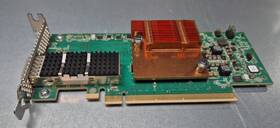
( Brand: Intel ), ( Manufacturer Part Number: J10548-021 ), ( Part Type: Adapter ), ( Compatible Port: Pci Express X16 )
Review INTEL 100gb/s Omni Path Host Fabric Low Profile Adapter
The **Intel J10548-021 100Gb/s RMN-100HFA016 Omni-Path Host Fabric Adapter** is a high-performance, enterprise-grade network interface card (NIC) designed to deliver unparalleled scalability, low-latency connectivity, and seamless integration into modern data center architectures. Built on Intel s advanced **Omni-Path Architecture (OPA)**, this adapter leverages a proprietary lossless fabric technology that ensures deterministic data transfer, making it an ideal solution for high-performance computing (HPC), artificial intelligence (AI) workloads, and large-scale distributed systems. With a blazing **100Gb/s** throughput capacity, the J10548-021 enables near-instantaneous data exchange between servers, clusters, and storage systems, significantly reducing bottlenecks in compute-intensive environments. Its **lossless fabric support** eliminates packet loss, ensuring reliable communication even under heavy network loads, which is critical for applications requiring strict consistency and low-latency responses, such as real-time analytics, financial modeling, or large-scale simulations.
The adapter is engineered with **Intel s Omni-Path Fabric**, a high-speed interconnect that supports advanced features like **remote direct memory access (RDMA)**, **infiniBand-like performance**, and **multi-path routing**, allowing for efficient offloading of network operations from the CPU. This not only reduces CPU overhead but also enhances overall system efficiency, enabling faster data processing and accelerated workload execution. The J10548-021 is compatible with a wide range of **Intel Xeon and Xeon Phi processors**, as well as other high-end server platforms, ensuring broad adoption across enterprise and HPC environments. Its **low-power design** and **compact form factor** (mezzanine or PCIe add-in card, depending on configuration) make it a space-efficient yet powerful addition to any server infrastructure, whether deployed in a traditional rack-mounted setup or within a modular blade system.
Beyond its raw speed and reliability, the Omni-Path Host Fabric Adapter incorporates **Intel s advanced networking stack**, including support for **RDMA over Converged Ethernet (RoCE)** and **TCP/IP**, providing flexibility for both traditional IP-based networks and high-performance fabric deployments. This dual-protocol capability allows organizations to consolidate their networking infrastructure while maintaining backward compatibility with existing Ethernet ecosystems. The adapter also features **Intel s Data Plane Development Kit (DPDK)**, enabling developers to optimize network performance through kernel bypass and hardware acceleration, further reducing latency and increasing throughput for specialized applications. Additionally, its **enterprise-grade security** includes features like **IEEE 802.1AE MACsec encryption**, ensuring data integrity and confidentiality across the network fabric.
Designed for **scalability and future-proofing**, the J10548-021 supports **multi-rail power delivery**, redundancy, and advanced error correction mechanisms, which enhance system resilience in mission-critical environments. Whether deployed in a **supercomputing cluster**, a **big data analytics platform**, or a **high-frequency trading infrastructure**, this adapter delivers the performance and reliability required to handle the most demanding workloads. With its seamless integration into Intel s broader ecosystem of networking and compute solutions, the **Intel J10548-021 Omni-Path Host Fabric Adapter** stands as a cornerstone for next-generation data center and HPC deployments, where speed, efficiency, and scalability are paramount.
**Pros and Cons of buying a Intel J10548-021 (100Gb/s RMN-100HFA016 Omni-Path Host Fabric Adapter)**
### **Pros**
1. **High Performance and Low Latency**
The Omni-Path architecture is designed for high-speed data transfer with low latency, making it ideal for HPC (High-Performance Computing), data analytics, and large-scale parallel processing workloads. It supports 100Gb/s throughput, significantly faster than traditional Ethernet or InfiniBand in many scenarios.
2. **Scalability and Flexibility**
Omni-Path supports multi-rail configurations, allowing for redundancy and improved reliability in large-scale clusters. It is compatible with Intel s Omni-Path network switches, enabling seamless scaling from small to very large systems.
3. **Energy Efficiency**
Omni-Path is known for its power efficiency compared to other high-speed interconnects like InfiniBand or traditional Ethernet, which can reduce operational costs in data centers.
4. **Compatibility with Intel Processors**
The adapter is designed to work seamlessly with Intel Xeon and other compatible processors, ensuring optimal performance in Intel-based server systems.
5. **Support for Advanced Features**
Omni-Path includes features like RDMA (Remote Direct Memory Access), which reduces CPU overhead by allowing direct memory access between nodes without kernel intervention. This is particularly beneficial for high-throughput applications.
6. **Future-Proofing**
The 100Gb/s speed and Omni-Path architecture provide a strong foundation for future workloads, including AI/ML training, genomics, and scientific computing.
7. **Reliability and Redundancy**
The RMN-100HFA016 model includes redundancy features, such as multi-path routing, which can improve fault tolerance in critical systems.
---
### **Cons**
1. **High Cost**
The Intel Omni-Path Host Fabric Adapter is significantly more expensive than standard Ethernet adapters or even some InfiniBand solutions. The cost may not be justified for smaller deployments or non-HPC workloads.
2. **Limited Adoption Outside HPC**
While Omni-Path is widely used in high-performance computing, its adoption in enterprise or general-purpose data centers is relatively limited. This could make finding support, documentation, or compatible hardware more challenging outside specialized environments.
3. **Complexity in Setup and Management**
Configuring and managing Omni-Path networks requires expertise in high-speed interconnects. Unlike standard Ethernet, it may require additional tools, software, and training to deploy and maintain effectively.
4. **Vendor Lock-In**
Omni-Path is primarily an Intel product, which means compatibility with non-Intel hardware (e.g., AMD EPYC servers) may be limited or require additional workarounds. This could restrict flexibility in hardware selection.
5. **Infrastructure Requirements**
To fully utilize the adapter, you need a compatible Omni-Path network switch and potentially additional hardware (e.g., QPI or UPI links for multi-socket servers). This adds to the overall cost and complexity of deployment.
6. **Overkill for Non-HPC Workloads**
If your use case does not involve high-performance computing, distributed computing, or large-scale parallel processing, the performance benefits may not be necessary, making the investment less justified.
7. **Limited Availability of Second-Hand or Refurbished Units**
Unlike consumer-grade hardware, Omni-Path adapters are less commonly found in the used market, which could limit options for cost savings.
---
### **Conclusion**
The **Intel J10548-021 (100Gb/s Omni-Path Host Fabric Adapter)** is a powerful and efficient choice for **high-performance computing, large-scale data processing, or environments requiring ultra-low latency and high throughput**. It excels in scenarios where traditional Ethernet or InfiniBand cannot meet performance demands, such as in supercomputing, AI training, or scientific research.
However, the **high cost, complexity, and niche applicability** make it less suitable for general-purpose data centers, small businesses, or non-HPC workloads. If your primary need is **enterprise networking, web servers, or standard database workloads**, a cheaper and more widely supported solution (e.g., 10Gb/s or 25Gb/s Ethernet) would likely be a better fit.
### **Recommendation**
- **Buy it if:**- You are deploying a **high-performance computing cluster** (e.g., HPC, supercomputing, AI/ML training).
- Your workload requires **ultra-low latency and multi-terabyte data transfer** (e.g., genomics, financial modeling, simulations).
- You are already using **Intel Omni-Path infrastructure** and need to scale further.
- Budget constraints are not a major concern, and you prioritize **future-proofing** for advanced computing needs.
- **Avoid it if:**- Your use case is **general enterprise networking, web hosting, or standard database operations**.
- You are working with **non-Intel hardware** (e.g., AMD EPYC) and lack compatibility guarantees.
- The **cost does not justify the performance gains** for your specific workload.
- You lack **expertise in high-speed interconnects**, as setup and troubleshooting may be challenging.
For most **non-HPC environments**, investing in a **10Gb/s or 25Gb/s Ethernet adapter** (e.g., Intel X710 or Mellanox ConnectX-3) would provide a better balance of performance, cost, and ease of use. The Omni-Path adapter is best reserved for **specialized, high-demand computing scenarios**.
Details:
J10548-021 Intel 100Gb/s RMN-100HFA016 Omni Path Host Fabric Low Profile Adapter: lock AR/61013, Conditions: Used. Warranty: 30-day warranty.
part #: j10548021 prices
- $18.14-$192.52
specifications diskcontrolle:
- brand: Intel
- mpn: J10548-021
- part type: Adapter
- compatible port: Pci Express X16
seller diskcontrolle:
- rating: 99.6%
- # reviews: 7879
- city: Hayward, California
returns diskcontrolle:
- method: Money back
- policy: Returns Accepted
- time: 30 Days
- paid by: Buyer
shipping diskcontrolle:
- service: USPS Ground Advantage
- transit: 4-9 Days
- carrier: USPS
- class: Standard
- type: Fixed
- cost: $0.00
payments diskcontrolle:
- credit card: Diners-club
- other
- wallet: Apple-pay
general diskcontrolle:
- Enterprise Networking, Servers > Server Components > Disk Controllers/RAID Cards
- condition: Used
offer diskcontrolle:
- options: Ship-to-home
- sold: 0
- started: April 12, 2026
- quantity: 3
- availability: In Stock
Intel J10548-021 Is Similar To:
- 100hfa016ls Intel Omni Path Host Fabric Adapter Series Computer 675901383615 (51% similar) 66 pounds size:n item DIMENSIONS:1. 8 anarchistic: 15...(August 7th, 2018)
- 00ag520 Pcie I350-t4 Card Baset Intel Network Gbe 4 Ibm Adapter (21% similar) 3AB, IEEE X4LOW profile low profiles specification revision pie brand new retail sealed for any questions or inquiries please at phone technical specifications environmental parameters humidity range operating non condensing max operating temperature 55 cumin operating temperature Chateaubriand ...(April 30th, 2015)
- Quad 0h092p Port Adapter 1000 Pro Dell Intel Network Pcie Vt Gigabit (21.6% similar) Only ship to the us...(April 15th, 2015)
- 0k9cr1 Dell Quad Port Low Profile Network Interface Adapter Intel (40% similar) Dell quad port pci-e low profile network interface adapter Intel I350 t4 part number: 0K9CR1 for tested packaged in eds anti-static bag...(September 23rd, 2018)
- Expx9502cx4 Dual-port Server 10gbe Pci 10gbase-cx4 Intel Adapter (17.9% similar) Continental destination, IE. Total tested. Condition used. In excellent working condition. In mint condition. No other accessories. This product ships FedEx ground, ups ground, or USPS. Intel part EXPX9502CX4 dual port 10GBASE CX4 use for server included the card only. Warranty 14 day warranty ...(March 30th, 2015)
- 32h3975 Intel Ibm Enhanced Ssa Adapter (37.3% similar) Please be certain you can use what are buying on, as incompatibility is not a valid reason for return. If it is not in the picture, does come with item unless stated. IBM 6216 32H3975 enhanced SSA 4-PORT adapter pulled from a working unit...(March 6th, 2018)
- 47c8152 Intel Ibm Dual Port Adapter Full Bracket (32.8% similar) IBM 47C8152 - Intel I350-T4 ML2 dual-port 10GB card new open box...(January 26th, 2019)
- Ethernet I340-t4 800123875 Port Gigabit Adapter Quad 49y4240 Ibm Server Intel (21.4% similar) Please refer to the photos to see the actual condition of the item and included accessories. Intel's first Eco friendly, halogen free design combines low power use and low cost for one of the best price to performance ratios in a multi port solution that is available today. Free shipping is not ...(April 23rd, 2015)
- C61794-001 Intel Sata Raid Adapter (33.3% similar) Intel pci-x 6-CHANNEL 64MB satay raid adapter C61794-001 condition: good this item is in cosmetic condition, although it may have some signs of wear. Pulled from a working environment and not refurbished. RU-DW-D1005-00NP...(May 17th, 2018)
- K7h46-high Dell Intel X540-t2 Dp 10gb Pci-e 2.1 X8 5.0 Gt S Ethernet Adapter P (38% similar) Shipping shipping shipping costs listed are to the 48 contiguous states. It creations. Or its subsidiaries in the USA and other countries. 0s Ethernet adapter K7H46 high pictures for display purposes only, please see for complete specifications. Buyer pays shipping and handling...(February 2nd, 2016)
- E10g41btdag1p5 Intel Single Port Ethernet Network Adapter Card (23.9% similar) Those of us at are also consumers. We recycle the older equipment and offer off any working components that retain value. If you are interested in this service. We won't offer free shipping...(May 2nd, 2018)