ALTERA YS05S16-0G Stratix Gx Pci Card PHB2 2.0/2.4 94V-0 E161964
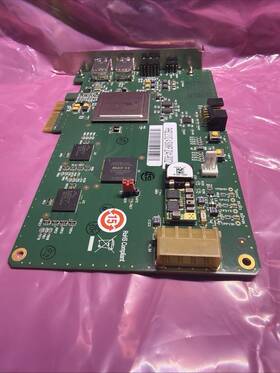
( Brand: Altera ), ( Manufacturer Part Number: YS05S16-0G ), ( Part Type: Card ), ( Network Ports: Sas ), ( Compatible Port: Pci ), ( Product Line: Megaraid )
Review ALTERA Stratix Gx 2.0/2.4 94v-0 Pci Card
The **Altera YS05S16-0G Stratix GX PHB2 PCIe Card** is a high-performance, field-programmable gate array (FPGA) solution designed for demanding applications requiring advanced networking, signal processing, and real-time data acceleration. Built around the **Stratix GX FPGA family**, this PCI Express (PCIe) card leverages the **PHB2 (PCIe Host Bridge 2.0/2.4)** architecture to deliver unparalleled flexibility and scalability, making it ideal for developers and engineers working on custom hardware acceleration, embedded systems, or high-speed data acquisition tasks. The **E161964** model incorporates a **94V-0** power rating, ensuring robust operation across a wide range of industrial and commercial environments while maintaining reliability under varying thermal and electrical conditions.
At its core, the Stratix GX FPGA provides a dense array of **logic elements, embedded memory blocks, and high-speed transceivers**, enabling parallel processing capabilities that outperform traditional CPU-based solutions. The **PCIe Gen 2.0/2.4 interface** ensures seamless integration with modern host systems, supporting data transfer rates up to **5 GT/s per lane**, which is critical for applications requiring low-latency communication, such as video processing, radar signal analysis, or high-frequency trading algorithms. The **PHB2 architecture** further enhances performance by offloading PCIe traffic management directly onto the FPGA, reducing host system overhead and improving overall system efficiency.
This PCI card is particularly well-suited for **custom hardware acceleration**, allowing engineers to implement proprietary algorithms, digital signal processing (DSP) functions, or real-time control logic directly on the FPGA. The **Altera Quartus Prime development environment** simplifies design implementation, enabling rapid prototyping and optimization of complex logic circuits. Whether used in **military-grade signal processing, aerospace telemetry systems, or industrial automation**, the Stratix GX PHB2 card delivers the computational power and deterministic performance required for mission-critical applications.
Additionally, the **modular and upgradeable nature** of the FPGA ensures long-term compatibility with evolving technological standards, making it a cost-effective solution for projects that demand both immediate performance and future scalability. With its combination of **high-speed I/O, embedded memory, and programmable logic**, the Altera YS05S16-0G Stratix GX PHB2 PCIe Card stands as a versatile tool for developers pushing the boundaries of embedded computing and real-time data processing.
The **Altera YS05S16-0G Stratix GX PHB2 2.0/2.4 GHz PCIe card** is a specialized FPGA-based hardware accelerator designed for high-performance computing, signal processing, and custom logic acceleration. Below is a detailed breakdown of its pros and cons, followed by a conclusion and recommendation.
---
### **Pros**
1. **High-Performance FPGA Core**
The Stratix GX FPGA (Altera s now-Intel FPGA line) is a mature, high-density device capable of handling complex parallel processing tasks. It supports advanced features like embedded multipliers, DSP blocks, and high-speed transceivers, making it suitable for custom hardware acceleration.
2. **PCIe Gen 2.0/2.4 Interface**
The PCIe x16 interface (with 2.0/2.4 GHz bandwidth) allows for high-speed data transfer between the FPGA and the host system. This is beneficial for real-time processing applications where low latency is critical.
3. **PHB2 (PCIe Host Bridge 2.0) Integration**
The PHB2 architecture enables direct PCIe root complex functionality, which can simplify integration into a system as a standalone accelerator or co-processor. This is particularly useful for custom I/O protocols or high-throughput data pipelines.
4. **Compatibility with Legacy and Modern Systems**
The card is designed to work with PCIe slots in modern servers and workstations, though compatibility may depend on the host system s BIOS and driver support. It can be used in both x86 and some ARM-based platforms, depending on the setup.
5. **Custom Logic Acceleration**
For applications requiring specialized processing (e.g., cryptography, image processing, or custom algorithms), the FPGA allows for hardware-level optimization that is often impossible in software alone. This can lead to significant performance gains over CPU/GPU solutions.
6. **Modular and Upgradable**
FPGA-based solutions can be reprogrammed or updated via bitstream changes, allowing for flexibility in adapting to new algorithms or requirements without hardware replacement.
7. **Low Latency for Real-Time Applications**
Since the FPGA operates at hardware speeds, it can process data with minimal delay, making it ideal for real-time systems like signal processing, robotics, or financial trading.
8. **Support for High-Speed Transceivers**
The Stratix GX includes high-speed serial transceivers (e.g., for 10G Ethernet, Fibre Channel, or custom protocols), which can be useful for data-intensive applications.
9. **Energy Efficiency for Parallel Tasks**
While FPGAs consume power, they can be more efficient than CPUs/GPUs for highly parallelizable tasks due to their ability to distribute workloads across logic blocks without the overhead of thread management.
10. **Potential for Cost Savings in Bulk Processing**
For applications where software solutions are too slow or expensive, an FPGA can reduce the need for additional GPUs or specialized hardware, lowering long-term costs.
---
### **Cons**
1. **High Upfront Cost**
FPGA-based accelerators like this card are significantly more expensive than general-purpose GPUs or CPUs. The cost may not be justified for small-scale or low-volume applications.
2. **Steep Learning Curve**
Developing and optimizing FPGA logic requires expertise in hardware description languages (VHDL/Verilog), synthesis tools, and timing closure. This can be a barrier for teams without FPGA experience.
3. **Limited Software Ecosystem**
Unlike GPUs (which have mature frameworks like CUDA or OpenCL), FPGAs lack standardized high-level programming tools. Developers often need to write custom logic or rely on proprietary tools (e.g., Intel Quartus, Altera s legacy tools).
4. **Development Time and Complexity**
Designing, simulating, and verifying FPGA logic can take months, especially for complex applications. This delays deployment compared to software-based solutions.
5. **Power Consumption**
FPGAs can draw significant power, particularly when operating at high frequencies or with large logic designs. This may require additional cooling or power considerations in the host system.
6. **Vendor Lock-In**
The Stratix GX is based on Intel s FPGA architecture, which means dependency on Intel s tools and potential compatibility issues with future hardware changes. Alternatives like Xilinx (now AMD) FPGAs may offer different trade-offs.
7. **Limited Mass Market Support**
Most consumer or enterprise software is optimized for CPUs/GPUs, not FPGAs. Integrating an FPGA-based accelerator may require custom drivers or middleware, adding complexity.
8. **PCIe Bandwidth Limitations**
While PCIe 2.0/2.4 GHz is sufficient for many applications, it may become a bottleneck for extremely high-throughput tasks (e.g., 40G Ethernet or AI inference with massive models). PCIe Gen 3/4 cards would offer better performance.
9. **Hardware Obsolescence Risk**
FPGA architectures evolve rapidly, and older models like the Stratix GX may become unsupported by vendors over time, leading to potential compatibility issues with newer software or tools.
10. **Not Ideal for General-Purpose Computing**
FPGAs excel at specialized tasks but are not efficient for general-purpose workloads (e.g., office applications, web browsing). They are best suited as co-processors, not replacements for CPUs.
11. **Physical Size and Form Factor**
PCIe cards like this one require a dedicated slot in the host system, which may not be available in all machines. Larger systems (e.g., servers) are more likely to accommodate them.
12. **Driver and Compatibility Issues**
PCIe cards often require custom drivers or kernel modules, which may not be available for all operating systems (e.g., Linux may need additional configuration, while Windows support can vary).
---
### **Conclusion**
The **Altera YS05S16-0G Stratix GX PHB2 PCIe card** is a powerful tool for developers and enterprises with specific needs for hardware acceleration, real-time processing, or custom logic. Its strengths lie in its high-performance FPGA core, PCIe integration, and suitability for parallel or low-latency tasks. However, it is not a plug-and-play solution; it requires significant expertise, development time, and infrastructure to deploy effectively.
This card is best suited for:- **High-performance computing** (HPC) applications requiring custom acceleration.
- **Signal processing** (e.g., radar, communications, audio/video).
- **Financial or scientific computing** where FPGA-based algorithms outperform CPUs/GPUs.
- **Prototyping or research** where flexibility and parallelism are critical.
- **Enterprise systems** with dedicated FPGA expertise and infrastructure.
It is **not ideal** for:- General-purpose computing or consumer applications.
- Teams without FPGA development experience.
- Applications where software-based solutions (e.g., GPUs, TPUs) are sufficient.
- Budget-conscious projects where the cost of development and hardware outweighs the benefits.
---
### **Recommendation**
**Buy this card if:**1. You have a **clear, well-defined use case** where FPGA acceleration provides a measurable advantage (e.g., custom algorithms, real-time processing, or high-throughput data pipelines).
2. Your team has **FPGA development experience** or is willing to invest in training (or has access to consultants).
3. You are working in a **high-performance or research environment** where the trade-offs (cost, complexity, and development time) are justified by performance gains.
4. Your host system has a **compatible PCIe slot** and sufficient power delivery for the card.
5. You are willing to **commit to the long-term maintenance** of FPGA logic and potential toolchain upgrades.
**Avoid this card if:**1. You lack FPGA expertise and cannot justify the learning curve.
2. Your application can be adequately solved with **CPUs, GPUs, or ASICs** at a lower cost.
3. You are working on a **small-scale or experimental project** where the upfront investment is prohibitive.
4. Your host system lacks the **necessary PCIe slot, power, or cooling** for the card.
5. You prioritize **ease of use and rapid deployment** over custom hardware optimization.
**Alternatives to Consider:**- **Xilinx/AMD FPGAs:** If you prefer a different vendor ecosystem, consider newer FPGA models like the **Xilinx Alveo U200** or **AMD Versal** for PCIe acceleration.
- **Intel FPGA PCIe Cards:** If you re locked into Intel s ecosystem, newer **Intel Stratix 10** or **Agilex** cards may offer better performance and features.
- **GPU Acceleration:** For AI, machine learning, or general parallel processing, **NVIDIA GPUs with CUDA** or **AMD GPUs with ROCm** may be more accessible.
- **FPGA Cloud Services:** If deploying hardware is impractical, consider cloud-based FPGA services (e.g., **AWS F1, Google Cloud FPGA**) for a more flexible approach.
**Final Verdict:**This card is a **high-end, niche solution** best reserved for specialized applications where FPGA acceleration is non-negotiable. For most users, the cost and complexity may not be worth the benefits unless you have a strong technical justification. If you proceed, allocate sufficient time and resources for development, testing, and integration.
Details:
With the trusted Altera brand behind it, this PCI card is a dependable option for those seeking top-notch network connectivity solutions. The Altera Stratix II GX YS05S16-0G PHB2 2.0/2.4 94V-0 E161964 PCI Card is a reliable and high-quality server component designed for enterprise networking. FREE GROUND SHIPPING It features SAS network ports and is compatible with PCI ports, making it ideal for use in servers. The Megaraid product line ensures data integrity and performance, making it a sought-after choice for businesses looking to enhance their server capabilities.
part #: ys05s160g prices
- $250.00-$399.99
specifications diskcontrolle:
- brand: Altera
- mpn: Ys05s16-0g
- part type: Card
- network ports: Sas
- compatible port: Pci
- product line: Megaraid
returns diskcontrolle:
- policy: No Returns
general diskcontrolle:
- Enterprise Networking, Servers > Server Components > Disk Controllers/RAID Cards
- condition: Used
shipping diskcontrolle:
- carrier: USPS
- type: Fixed
- service: USPS Ground Advantage
- transit: 4-10 Days
- cost: $0.00
- class: Standard
seller diskcontrolle:
- # reviews: 813
- rating: 100.0%
- city: San Diego, California
payments diskcontrolle:
- wallet: Paypal
- credit card: Diners-club
- other
offer diskcontrolle:
- availability: In Stock
- sold: 0
- best offers: True
- quantity: 1
- started: May 2, 2026
- options: Ship-to-home