SUPERMICRO AOC-UR-I4XTF Network Card Riser Pcie Adapter 772042991089 4-PORT 10GBE 1U
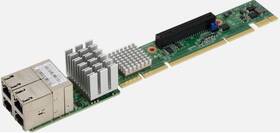
( Brand: Supermicro ), ( Type: 4aoc-ur-i4xtf ), ( Unit Type: Unit ), ( Number Of Ports: 4-port ), ( Compatible Port: Pci ), ( UPC: 772042991089 )
Review SUPERMICRO 4-port Network Card 1u Riser Pcie Adapter
The **Supermicro AOC-UR-I4XTF** is a high-performance, enterprise-grade 4-port 10 Gigabit Ethernet (10GbE) network adapter designed for demanding data center and server environments. Engineered with precision for reliability and scalability, this **1U riser PCIe adapter** delivers seamless connectivity for applications requiring robust, low-latency networking, including virtualization, storage area networks (SANs), cloud computing, and high-performance computing (HPC) workloads. Built on a **PCIe x8 Gen 3** interface, the card ensures optimal bandwidth and throughput, making it ideal for servers equipped with modern Intel Xeon or AMD EPYC processors. Its **4-port configuration** provides redundant and load-balanced connectivity, minimizing single points of failure while maximizing network efficiency perfect for mission-critical infrastructure where uptime and performance are non-negotiable.
The **AOC-UR-I4XTF** incorporates **Intel X550T 10GbE controllers**, renowned for their advanced features such as **offload capabilities**, including TCP/IP checksum, segmentation, and large send offload (LSO), which significantly reduce CPU overhead and enhance overall system performance. Each port supports **Full-Duplex communication at 10 Gbps**, ensuring symmetrical data transfer rates for both sending and receiving, while the **low-power design** (TDP: 10W) maintains energy efficiency without compromising performance. The card is compatible with a wide range of **10GbE network standards**, including **RJ45 (copper) and SFP (fiber)**, offering flexibility for deployment in environments with either cabling infrastructure. Whether deployed in a **direct-attached storage (DAS) setup, a converged network fabric, or a high-speed interconnect for clustered systems**, this adapter delivers the speed, stability, and versatility required to meet the most rigorous networking demands.
Designed with **Supermicro s signature attention to detail**, the **AOC-UR-I4XTF** features a **compact 1U riser form factor**, allowing seamless integration into standard server racks without sacrificing space. The **low-profile PCIe riser** ensures compatibility with a broad range of Supermicro and third-party server platforms, including the **Supermicro AS-7041T-RF, AS-7041T-RF , and AS-7041T-RF TR** systems, among others. The card s **hot-swappable design** further enhances operational flexibility, enabling maintenance or upgrades without disrupting critical operations. Additionally, the **Intel-based hardware** ensures broad compatibility with major operating systems, including **Windows Server, Linux distributions (such as Red Hat Enterprise Linux and Ubuntu), and VMware ESXi**, making it a versatile choice for heterogeneous environments. With **Supermicro s commitment to reliability and long-term support**, this adapter is built to endure the rigors of 24/7 data center operations, providing a future-proof solution for evolving networking needs. Whether deployed in a **high-availability cluster, a virtualized data center, or a next-generation AI/ML workload**, the **AOC-UR-I4XTF** delivers the speed, resilience, and adaptability required to power modern IT infrastructure.
### **Pros and Cons of the Supermicro AOC-UR-I4XTF (772042991089) 4-Port 10GbE Network Card**
#### **Pros:**1. **High Performance and Bandwidth** The card provides four 10GbE ports, delivering aggregate bandwidth of 40Gbps, which is ideal for high-throughput applications such as data centers, HPC clusters, virtualization, and storage networks. This makes it suitable for environments requiring low latency and high-speed data transfer.
2. **Reliability and Enterprise-Grade Build** Supermicro is a well-known manufacturer in the server and data center hardware space, known for durable, high-quality components. This card is designed for 24/7 operation in demanding environments, reducing the risk of failures.
3. **Low Latency and High Throughput** The card supports advanced features like **RDMA (Remote Direct Memory Access)**, which is crucial for applications like databases, big data processing, and high-frequency trading. This reduces CPU overhead and improves overall system efficiency.
4. **PCIe 3.0 x8 Interface** The card uses a PCIe 3.0 x8 slot, which provides sufficient bandwidth for 10GbE traffic without becoming a bottleneck. This ensures stable performance even with high data loads.
5. **Compatibility with Supermicro Servers** This card is designed specifically for Supermicro motherboards, ensuring seamless integration with their chassis and power delivery systems. It is particularly well-suited for Supermicro s **7041 series** and other **1U/2U servers** with appropriate PCIe slots.
6. **Support for Advanced Networking Features** The card supports **VLAN tagging, Jumbo Frames (up to 9KB), and offloading features** such as TCP/IP checksum, segmentation, and large receive offload (LRO). These features enhance network efficiency and reduce CPU load in high-traffic environments.
7. **Hot-Plug Capability** The card supports hot-swappable ports, allowing for maintenance or upgrades without downtime, which is a critical feature in production environments.
8. **Energy Efficiency** Supermicro cards are generally designed to be power-efficient, reducing operational costs in large-scale deployments.
9. **Wide Compatibility with OS and Hypervisors** The card is supported by major operating systems, including **Linux (RHEL, Ubuntu, CentOS), Windows Server, and VMware ESXi**. This makes it versatile for various virtualization and cloud environments.
10. **Future-Proofing** While the card uses PCIe 3.0, its 10GbE speed is still relevant for many applications, and Supermicro s reputation ensures compatibility with future firmware updates.
---
#### **Cons:**1. **PCIe 3.0 Limitations** While PCIe 3.0 x8 is sufficient for 10GbE, it may become a bottleneck if future upgrades to **PCIe 4.0 or 5.0** are needed. However, for most 10GbE applications, this is not a significant issue.
2. **Cost** High-performance network cards like this one are more expensive than standard 1GbE or even some 2.5GbE cards. The price may be prohibitive for small businesses or non-critical applications.
3. **Power Consumption** Like most high-speed network cards, this one consumes more power than standard NICs. In large-scale deployments, this can add up to higher electricity costs.
4. **Limited Port Density** While four ports are useful, some applications (e.g., large-scale storage networks or high-density servers) may require **more ports or higher speeds (25GbE/40GbE/100GbE)**. This card does not offer flexibility for future upgrades in port count.
5. **Firmware and Driver Dependencies** Some advanced features (e.g., RDMA, VLANs) require proper driver support. In rare cases, compatibility issues may arise with certain OS versions or hypervisors, requiring manual troubleshooting.
6. **Physical Space Constraints** As a **1U riser card**, it occupies space in the server s PCIe slot, which could be used for other expansion cards if needed. However, this is less of an issue in dedicated network or storage servers.
7. **No Built-in Management Features** Unlike some enterprise-grade NICs (e.g., Mellanox Spectrum or Broadcom), this card does not include **dedicated management interfaces** (e.g., iWARP, RoCE v2 support for NVMe over Fabrics). While it supports RDMA, it may lack some advanced management tools found in higher-end cards.
8. **Potential Compatibility Issues with Non-Supermicro Servers** While the card is designed for Supermicro systems, using it in a non-Supermicro chassis may lead to **power delivery or slot compatibility issues**, though it should work technically.
---
### **Conclusion**
The **Supermicro AOC-UR-I4XTF 4-port 10GbE riser card** is an excellent choice for **enterprise, data center, HPC, and virtualization environments** where high-speed, low-latency networking is critical. Its reliability, performance, and compatibility with Supermicro hardware make it a strong option for servers requiring multiple 10GbE connections.
However, it is **not ideal** for budget-conscious users, small businesses, or applications that do not require 10GbE speeds. Additionally, those needing **higher port densities or future-proofing for 25GbE/40GbE** may need to consider more advanced (and expensive) solutions.
---
### **Recommendation**
- **Buy this card if:**- You are deploying a **Supermicro server** in a **data center, HPC cluster, or virtualized environment** where 10GbE performance is essential.
- You need **four 10GbE ports** for redundancy, high throughput, or RDMA-capable applications (e.g., databases, big data, storage networks).
- You prioritize **enterprise-grade reliability** and **low-latency networking**.
- **Consider alternatives if:**- You need **more ports** (e.g., 8x 10GbE or 25GbE/40GbE) Look at **Mellanox ConnectX-3/4/5** or **Broadcom NetXtreme E-series**.
- You are on a **tight budget** A **2.5GbE or 5GbE card** may suffice for less demanding workloads.
- You require **advanced management features** (e.g., iWARP, RoCE v2) Higher-end Mellanox or Broadcom cards may be better.
- You are not using **Supermicro hardware** Ensure PCIe slot and power compatibility before purchasing.
For most **Supermicro-based high-performance servers**, this card is a **solid, cost-effective choice** that delivers excellent value for its intended use case.
Details:
Notes:: Normal signs of previous enterprise use may be present light scuffs/scratches from installation or removal. Data security compliant: This device does not contain storage media; therefore, no end-user data is present. The Supermicro AOC-UR-I4XTF is a 1U riser PCIe adapter that provides 4 ports of 10GbE network connectivity. ESD-safe packaged to help prevent damage in transit.
Supermicro AOC-UR-I4XTF 4-Port Network Card / 1U Riser only what is pictured unless stated otherwise. Cleaned and prepared for resale. Each unit is: Inspected for physical condition and basic functionality.
part #: 772042991089 prices
- $84.96-$650.00
specifications diskcontrolle:
- brand: Supermicro
- type: 4aoc-ur-i4xtf
- unit type: Unit
- number of ports: 4-port
- compatible port: Pci
- upc: 772042991089
seller diskcontrolle:
- # reviews: 238
- city: Piscataway, New Jersey
- rating: 97.7%
general diskcontrolle:
- Enterprise Networking, Servers > Server Components > Disk Controllers/RAID Cards
- condition: Used
returns diskcontrolle:
- method: Money back
- policy: Returns Accepted
- time: 30 Days
- paid by: Seller
shipping diskcontrolle:
- type: Calculated
- cost: $0.00
- transit: 2-6 Days
- service: FedEx Ground Economy
- carrier: FedEx
- class: Economy
offer diskcontrolle:
- availability: In Stock
- sold: 0
- started: February 26, 2026
- options: Ship-to-home
- quantity: 10
payments diskcontrolle:
- other
- credit card: Visa
- wallet: Paypal
Supermicro 10GBE Is Similar To:
- 9550sxu-4lp 700-3189-05 3ware Amcc 4-port Sata Raid Controller Pci-x Supermicro W Cables (17.4% similar) Pulled from working server. Full height card...(July 28th, 2016)
- 500007-0002g Chenbro-supermicro Supermicro 4-port Sfp Gigabit (27.6% similar) Inc: 3C90234 used condition Nebr Supermicro server 4-PORT SPF gigabit Ethernet raid card satay cables network instruments SATA-2GIGABIT card part no: with transceivers and 8x cables...(August 11th, 2017)
- Aoc-ibh-002 8f82848-10-14 Lot Megaraid Abm-800t Raid Backup Battery Card Lsiibbu07 Supermicro (11.3% similar) Customer should in advance to schedule for a pickup. However larger items and quantity orders take more time to pack. Boxes, APO, FPO and military bases...(December 8th, 2015)
- A0c-s2208l-h8ir Supermicro Lot Of Channel Raid Card 658759000682 (29.7% similar) Substitute part numbers:with it parts, there are often identical sub numbers available for that which merely designate factory the item was made at or perhaps production batch. Please investigate your local import requirements prior to purchase as there may be such fees at the time of or receipt. ...(August 24th, 2018)
- A0c-s2308l-l8i Supermicro Raid Controller Pcie (32.3% similar) Item has slight signs of use or wear, very minor surface scratches and imperfections. Item has major signs of use or wear, such as deep surface scratches, gauges imperfections, unreadable missing laptop keys, case cracks, damaged ports, hard drive label nicks damage, connector bezels, loose hinges, ...(March 13th, 2018)
- Aoc-cgp-i2 Supermicro New Gigabit Card Intel Ethernet Controller 672042110810 (29.8% similar) New Supermicro AOC-CGP-I2 2PORT gigabit card intel Ethernet controller I350 pci-express 3 auto-negotiation for speed, duplex, flow control - IEEE, 802. 1 retail these microloan adapters are the latest innovation from Supermicro, designed to fit easily inside densest systems. 5GTS or interface - dual...(October 18th, 2018)
- Aoc-lpzcr1 Supermicro Card Raid (31.3% similar) Supermicro add-on card AOC-LPZCR1 all-in-one zero-channel 64MB pci-x raid...(November 14th, 2018)
- Supermicro Pci Sas Raid channel Aoc-lpzcr2 Sata Card profile (38.1% similar) Please if you do not have a street address. Condition please view photos great condition with no damage. Please do call us if there are any questions or concerns at. If item value is expedited shipping available, call us for a quote. Please do call us if there are any questions or concerns at...(May 26th, 2015)
- Pc Battery Aoc-lpzcr3 Controller Card Adaptec Channel Raid Supermicro (13.1% similar) This listing is for a Supermicro aoc LPZCR3 raid controller card. This was pulled from a fully functional environment. There may be a 15 re stocking fee depending on the circumstances of the return...(March 27th, 2015)
- Aoc-s2308l-l8i Supermicro Super Pcb Pcie Storage Controller Module Card (31% similar) 30-DAY DOA warranty this product carries. Please review images thoroughly before purchasing. Standard shipping prices are only good for the lower 48 states. All pictures are taken in house. Our contact: Rodney Wang SC asset management, inc. If you do receive the package, submit clear images of ...(September 17th, 2018)
- Aoc-s3008l-l8e Supermicro Port Sas Internal Host Bus Adapter (38.9% similar) Please see actual pictures. Theres no other parts, manuals, software included...(May 15th, 2018)